Below are my thoughts, notes and ideas, blended together after reading two chapters on Learning Intentions and Success Criteria. The readings were Shirley Clarke’s Unlocking Formative Assessment and the other was Michael Absolum’s Clarity in the Classroom. Both chapters serve as extremely practical guides to ensure that Learning Intentions and Success Criteria are key parts of both a teacher’s planning and also their classroom culture.
Perhaps my biggest take way from the readings was the reminder that there are two aspects to good Learning Intentions – the teachers planning and then in the classroom implementation. It is one thing for them to be written in planning but it is another thing to use them effectively in class through co-construction and clear implementation with students.
My Learning Notes…..
A crucial aspect of effective learning is the establishment and use of learning intentions and success criteria. These elements guide educators in shaping their lessons, give their students clear feedback, while also empowering students to take ownership of their learning journey.
The Foundation of Formative Assessment
Learning Intentions are vital for effective formative feedback. Furthermore, the foundation of effective formative assessment lies in the alignment between learning intentions, success criteria, and achievement objectives. Achievement objectives provide the overarching goals of learning, setting the stage for defining specific learning intentions. These intentions articulate what educators aim to impart to students, encompassing skills, knowledge, attitudes, and values.
Clarity is key when formulating Learning Intentions and Success Criteria. Learning Intentions serve as the focal point of formative assessment, guiding teachers in designing instruction that targets specific learning outcomes. Success Criteria, on the other hand, offer students a clear roadmap for achieving those outcomes. By ensuring that success criteria are explicit and well-defined, educators facilitate effective monitoring of student progress throughout the learning process.
Below is an example of a clear learning intention and success criteria
Learning Intention:
We are learning to write a short, exciting, narrative.
Success Criteria:
The narrative will have an introductory paragraph and a conclusion.
The narrative will sequence events.
The narrative will use the present tense to build a sense of immediacy and urgency.
In Michael Absolum’s Book – Clarity in the Classroom he advocates for a final focus on relevance. “When teachers consider the relevance of the learning intention it will often challenge its quality”.
For example, learning to use capital letters and full stops as a learning intention is
thin in quality, without the thinking around why and how punctuation is important. After thinking, it may well be that the learning intention changes to become much richer; for example, we are learning to make our ideas clear to the reader. The capital letters and full stops then become the success criteria that evidence this learning. The example below shows how we can move from Learning Intention to Success Criteria to Relevance.
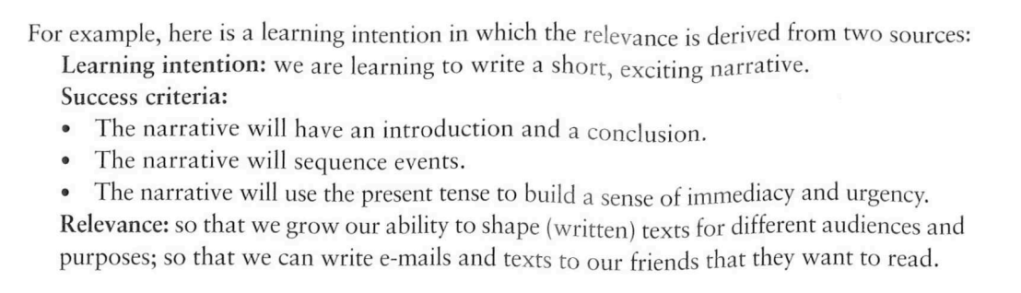
A noteworthy aspect highlighted in Clark’s chapter is the empowerment that learning intentions and success criteria give to students. When learning intentions are clearly communicated and success criteria are clearly defined, students gain a deeper understanding of the purpose behind their learning tasks.
Moreover, involving students in the creation of success criteria enhances their engagement and investment in the learning process, as they develop a sense of ownership and agency.
Cultivating a Learning Culture
To foster a culture of learning, educators can take these practical steps outlined in both of these readings:
- Ensure clarity in learning intentions.
- Differentiate between learning intentions, success criteria, and task instructions.
- Co-construct Success Criteria with students.
- Communicate the relevance of learning objectives to students.
- Visually display learning intentions and success criteria.
- Encourage student involvement by asking them to read aloud and discuss learning intentions and success criteria.
Learning intentions and success criteria serve as important aspect in an effective classroom programme. By using clear Learning intentions and Success Criteria in their teaching practices, educators can create environments where clarity, purpose, and student empowerment thrive.


Leave a comment