Last week, I had the chance to attend a two-day leadership course in Rotorua run by Evaluation Associates | Te Huinga Kākākura Mātauranga. I went with a group of 12 from Mount Maunganui Intermediate – four from our senior leadership team and eight of our team leaders.
It’s not often we get the space to step away from school and spend time really thinking about the kind of leaders we are – and the kind we want to be. This was one of those rare opportunities. A chance to pause, reflect, learn, and reset.
We were guided by an excellent team:
- Bobby Ketu brought challenge and grounding. His presence and cultural lens helped centre our thinking.
- Lisa Morresey offered practical leadership strategies that made sense for a school setting.
- Doreen Bailey encouraged us to reflect deeply on our current practice and impact.
Three Tools That Anchored Our Thinking
Across the two days, we used three key tools that helped shape our conversations and reflections.
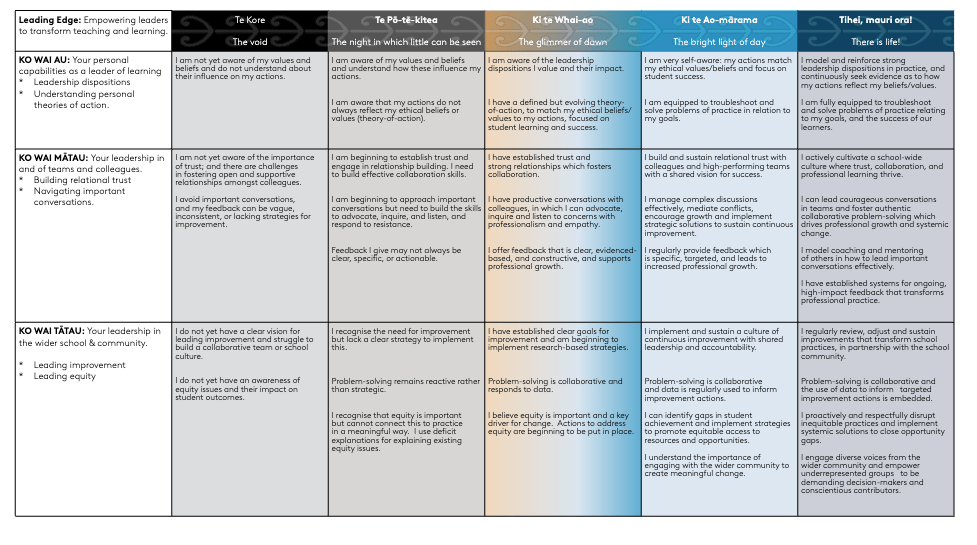
1. Arotake Whaiaro – Self-review through a Māori lens
This was the main framework we used. It asked us to look at three areas of leadership:
- Ko Wai Au – Who am I as a leader?
This helped us reflect on our values, beliefs and leadership behaviours – and whether they’re actually aligned. It was a reminder that what we say we believe (our espoused theory) isn’t always what we do in practice (our theory in use). - Ko Wai Mātau – Who are we as a team?
This part focused on relationships – how we build trust and have the kinds of conversations that actually move things forward. Are we really listening to each other? Are we being clear and kind in our feedback? It made me realise how important it is to make space for people to feel safe and heard.
- Ko Wai Tātau – Who are we as a school and community?
This zoomed out to look at our wider impact. Are we leading improvement that makes a difference for all learners? Are we challenging inequity, or unintentionally reinforcing it?
What I really liked about the Arotake Whaiaro tool was the way it used te ao Māori stages of development to describe leadership growth:
- Te Kore – The void, full of potential
- Te Pō-tē-kitea – The night where little can be seen
- Ki te Whai-ao – The glimmer of dawn
- Ki te Ao-mārama – The bright light of day
- Tihei, mauri ora! – There is life!
2. Theory-in-Action Template – Walking the Talk
This tool helped us look closely at the relationship between our beliefs, our behaviours, and the impact we’re aiming for. It challenged us to name:
- Beliefs – What do I believe about effective leadership?
- Actions – What do I actually do?
- Outcomes – What impact am I trying to have?

This was an important check-in: Are my actions lining up with my values and intentions? And if they’re not, what’s getting in the way?
It reminded me that leadership isn’t just about doing the right things – it’s about understanding why we do them, and whether those actions are landing in the way we hope.
3. Wetekia – A Thinking Tool for Improvement
The third tool we explored was Wetekia – a powerful structure for leading improvement work in a school. More about that tool a little later.
Putting Leadership into Action
One of the most powerful parts of conference was the 2nd day when we got to look at our own school data using the Wetekia tool. Despite students spending two full years with us this is what our data says…
- 35% of our students make two years’ progress in maths.
- 33% of our students make two years’ progress in reading.
- 54% of our students make two years’ progress in writing.
That’s not easy to see. But it’s important. Because it raises the question:
Who is our current system not working for?
What changes do we need to make?
What are we doing – or not doing – that’s getting in the way of progress?
Is our assessment fit for purpose?
Wetekia – A Plan for Action
To help us respond to this data, we used the Wetekia tool. It breaks improvement down into four phases:

- WHAI – Define the gap – what is the main issue?
- AKO – Learn and unlearn – what could be the reason?
- MAU – Put new ideas into action – what could be a solution?
- TIPU – Review the impact
It helped us realise that we often rush to fix things without really understanding the cause. The AKO stage reminded us to take time, gather evidence, and challenge assumptions. Growth happens when we slow down and get curious – not when we rush to quick fixes.
As you would imagine for something as big as student data, this tool will take us a little time to work through. That will be our work stream for the next few weeks for the the wider leadership team at MMI.
Other Personal Reflections during the 2 Days
Our Role as Middle Leaders
As team leaders and SLT, we talked a lot about the unique challenges of leading from the middle. You’re still in the classroom, but you’re also leading adults. You’re part of the wider leadership team, but also supporting your own teams.
We talked a lot about relational trust and how this is the foundation of a good school. We explored how this is developed and what we as leaders can do to ensure we have it in our school.
Relational Trust
Lencioni’s Five Dysfunctions of a Team has been sitting in the back of my mind since our Rotorua course. His pyramid model for building strong teams – starting with trust and building up to results – really connects with the Arotake Whaiaro framework we explored.

The alignment between Lencioni’s model and the three leadership domains we used on the course is pretty clear:
- Ko Wai Au – Who am I as a leader
- Ko Wai Mātau – How I relate to others and lead in teams
- Ko Wai Tātau – How I influence the wider system
Each of these requires different things from me as a leader – but they all rely on the same foundation: relational trust and clarity of purpose.
It’s made me think: Am I showing up as the same leader in all three spaces? And more specifically: Am I using my strengths consistently across each of these domains?
If I look at some of my leadership strengths – Reflectiveness, Respectfulness, Collaboration, Big Picture Thinking, and Loyalty – I know these serve me well in one-on-one relationships and in strategic planning. But I’m also aware that strengths can become limitations if they aren’t consciously applied across the board.
- Am I being reflective enough in the moment, not just after the fact?
- Does my loyalty ever stop me from leaning into necessary conflict?
- Am I making space for other voices while holding the bigger vision?
These are the questions I’m sitting with.
The Stretch Zone – Learning Talks and Coaching
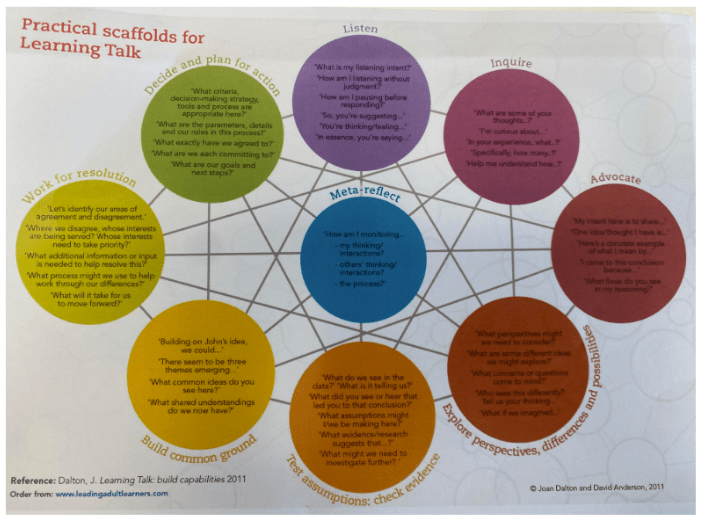
Another area I’m aware I need to keep growing in is using practical scaffolds for learning-focused conversations – especially in coaching or mentoring contexts. I’ve been working on it, and I’m definitely better than I was. But it’s still a stretch zone.
What I’m learning is that good conversation isn’t about having the answers – it’s about listening in the right way and asking the right kind of questions.
Some of my biggest learning has come from focusing on the micro-skills of coaching:
Listening
- Clarify your intention – What’s my role in this kōrero? Am I coaching, supporting, or leading?
- Suspend judgement – I’m getting better at this, but it takes discipline.
- Attend fully – Being present is everything. Even five seconds of full attention can shift a conversation.
- Pause and reflect – I’m learning that silence is not awkward, it’s generous.
- Paraphrase – A simple paraphrase can show people they’ve really been heard.
Bringing It All Together
For me one of the key take away words from the two days was alignment.
Alignment between my inner self (Ko Wai Au), my relationships with others (Ko Wai Mātau), and my impact across the school (Ko Wai Tātau).
Alignment between what I believe, what I do, and what others experience.
And alignment between the systems we use (like Wetekia, Arotake Whaiaro, and Theory-in-Action), and the everyday conversations that build our culture.
Alignment at MMI with our SLT Team and our Team Leaders.
Finally I learnt that sometimes what you wish for doesn’t happen. I had envisaged a beautiful RolyPoly in front of the Rotorua Government Gardens with the early morning sun. Instead, the sprinklers were on, there was shrink wrap on the buildings and the day was foggy. When life gives you lemons – make lemonade.


Leave a Reply